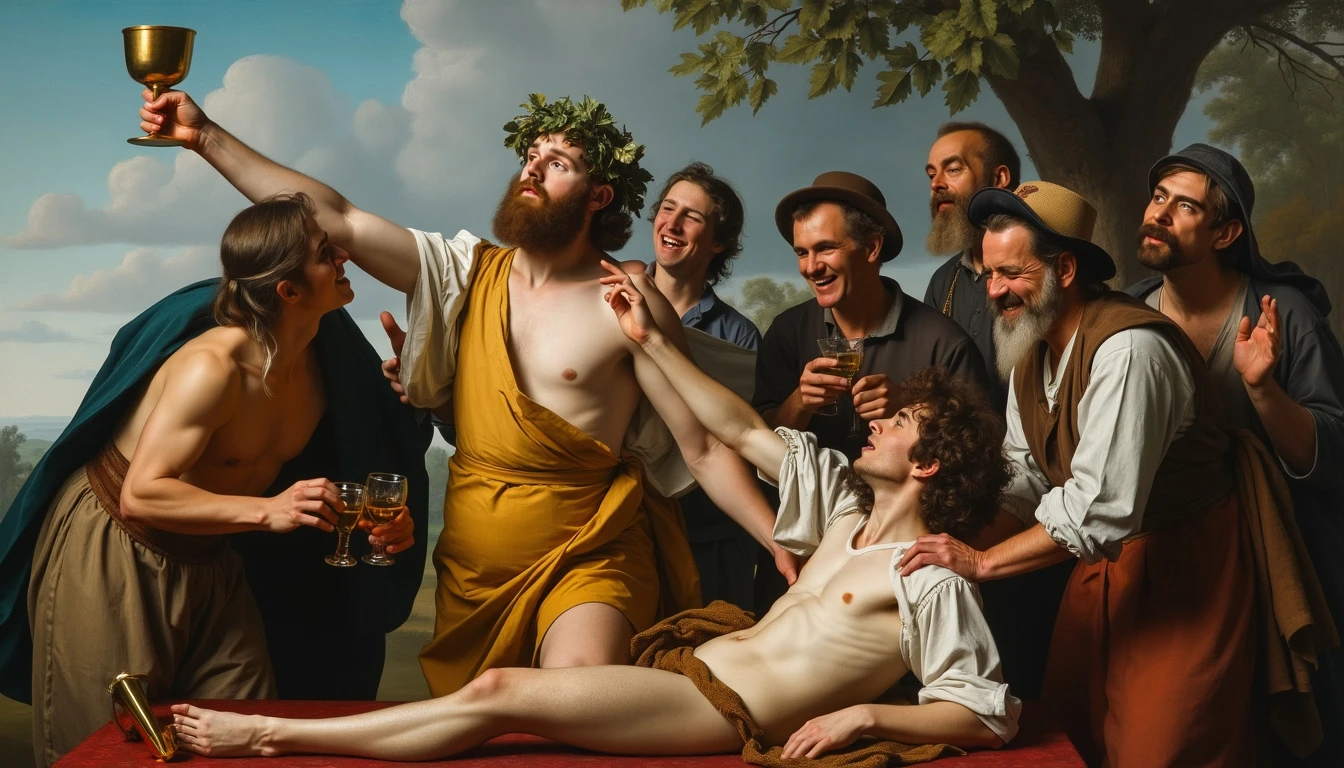
Professional hyperrealistic photography recreating the painting "The Triumph of Bacchus," also known as "The Drunkards," is a work by the Spanish painter Diego Velázquez, depicting a mythological scene fused with elements of daily life of his time. The painting shows nine characters gathered in a country setting. At the center of the composition is Bacchus, the Roman god of wine, crowned with vine leaves. Around him, a group of peasants and rustic-looking men interact in a celebration of drink and joy. Bacchus (central figure): He is a fair-skinned young man . His head is adorned with a crown of vine leaves, and he holds a golden cup aloft, suggesting that he is toasting or celebrating. His expression is serene, almost absent, looking forward, while the other men surround him. Peasants: To the right of Bacchus, a middle-aged man, with a beard and a smiling expression, is in the foreground. He is wearing a yellow vest and white shirt, and leaning forward, as if he were talking to another character or approaching Bacchus. Another man at his side, wearing a brown cloak and a grey beard, is also looking on with interest. Further to the right, there are two other men, one of them pointing with a finger towards Bacchus, and the other watching with a curious gesture. Figure to the left of Bacchus: A young man, also crowned with vine leaves, is lying down, holding a golden cup in his left hand. This character seems relaxed and smiling, taking part in the celebration. Figures in the background and to the right: Three more men, one of them wearing a wide hat that partially hides his face. Another character, wearing a dark cloak, seems to be leaning his head towards his hand, covering his eyes or laughing discreetly. Atmosphere and details: The background of the painting suggests a rural landscape with a cloudy sky, although it is not very detailed. The light in the painting comes mainly from the front left, illuminating the central figures of Bacchus and the man in the yellow vest, creating dramatic contrasts in the fabric and the faces of the characters. The predominant colors are warm tones such as browns, golds, and ochres, with touches of red and pink in the fabrics. Technical elements to recreate the photograph: Lighting: Use soft, natural lighting that simulates diffuse sunlight coming from the left side. Use a reflector to soften the shadows on the faces and bodies of the characters, especially highlighting Bacchus and the man to his right. Costume and accessories: The characters should wear rustic and simple clothing that imitates the style of the 17th century, such as linen shirts, vests, capes, and crowns of vine leaves for Bacchus and the young man to his left. (No character should wear a hat: 1.3). Include details such as wine jugs, golden goblets, and terracotta elements to recreate the festive and country atmosphere. (No anachronistic elements should appear: 1.3) Poses and expressions: Instruct the models to adopt relaxed poses but with a sense of interaction and camaraderie. Bacchus should have a dominant but relaxed posture, with a serene expression. The other characters should show smiles, curious glances, and conversational or toasting postures. Setting and background: Place the scene in an outdoor environment, preferably with vegetation and a blurred background that simulates a natural landscape. Use techniques that give the photo realistic authenticity and cancel out the pictorial effect of the background in the painting. Photographic composition: Use a medium focal lens to capture the scene in its entirety, maintaining a sharp focus on the main characters while blurring the details of the background. Keep the frame slightly centred on Bacchus, ensuring that the supporting characters form a semi-circle around him, as in the painting. By following these guidelines, you will be able to recreate a photograph that captures the essence and spirit of Velázquez's "The Triumph of Bacchus", with a modern and realistic approach using live characters and contemporary photographic techniques.