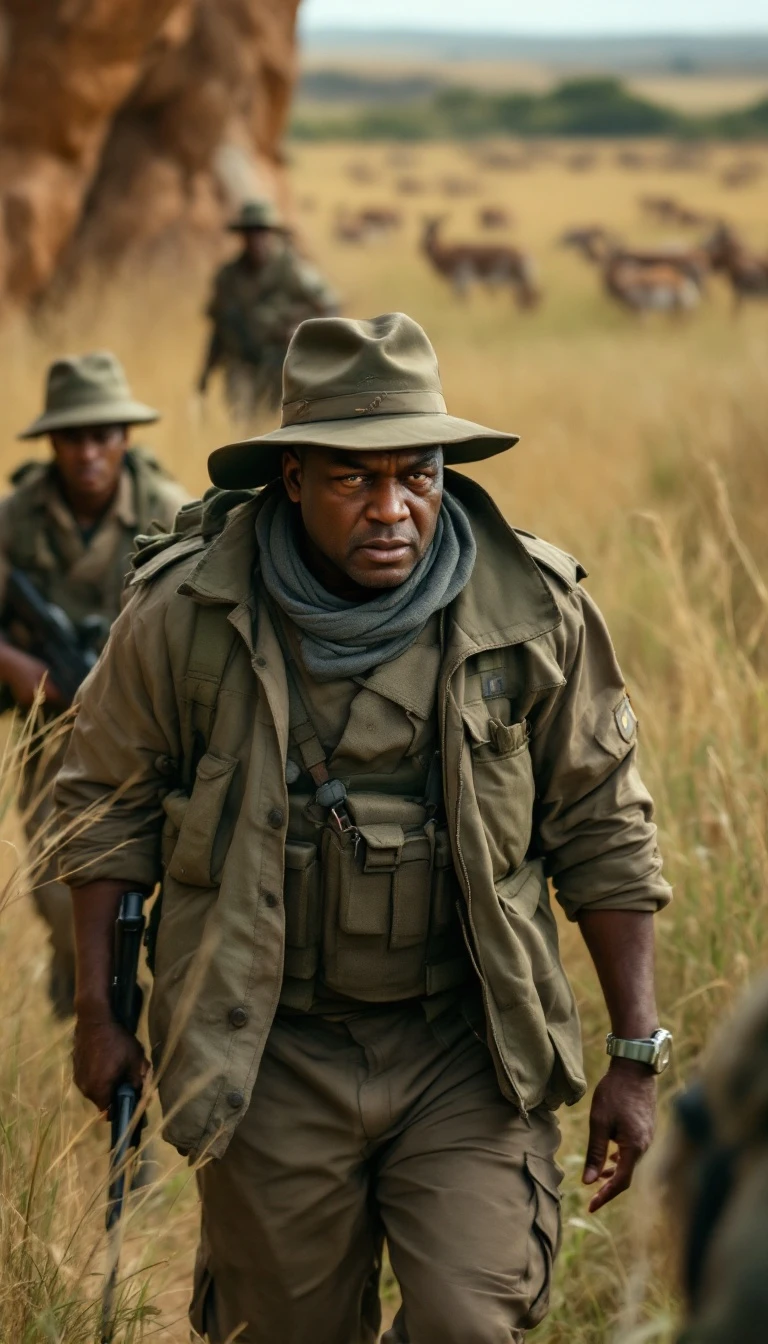
Cyril Ramaphosa leads a team of South African soldiers through the savanna, the muted green and tan of their camouflage blending into the wild grass around them. His uniform is disheveled, his jacket slightly torn from brushing against the tall grasses, while his wide-brimmed military hat is dented from days of wear. His rifle is firmly aimed at the ground, ready for any sudden threats. His determined expression cuts through the heat as he scans the horizon, calculating every step. The soldiers follow him with measured caution, moving through the tall grass in perfect synchronization, their boots leaving deep prints in the soil. The scorching African sun beats down on them, causing sweat to drip down their foreheads. In the distance, a herd of antelope grazes peacefully, unaware of the silent danger nearby. Ramaphosa pauses, gesturing for his team to take cover behind a rocky outcrop, the tension in the air palpable. The camera focuses on his rugged appearance—the creased tactical vest, a camouflage band around his arm, and the dirt streaking across his face—as he surveys the terrain, prepared for any hostile encounter.